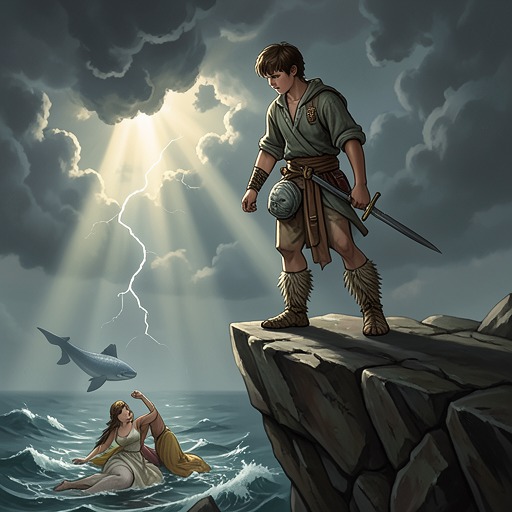
Perseus and Phineus
Metamorphoses (Ovid Edition)Perseus and Phineus is the decisive conflict at the palace of Cepheus, where a disputed marriage erupts into armed violence and Perseus must defend both his bride and the promise that brought him to her. The episode’s central reversal is that the invaders’ numerical strength becomes their ruin: Medusa’s head, displayed as a weapon of transformation, turns the wedding hall into a field of stone and leaves Phineus alive only long enough to recognize the catastrophe his challenge has caused.
Causes and Background
The conflict begins during the continuation of Perseus’s story in Book Five, after Perseus has returned to the palace of Cepheus. Phineus appears as the principal instigator of the disturbance, described as the rash ringleader of a turbulent crowd. His intervention makes the feast more than a private celebration. It becomes a contest over whether Andromeda’s marriage to Perseus will be acknowledged, and whether the old claim of the betrothed will yield to the hero who rescued her.
The opposition is intensified by the palace’s tangled family relations. Cepheus runs to restrain Phineus and appeals to him as a brother, asking what brutal rage has made him conceive so black a crime. The appeal identifies the violence as both political and domestic: Phineus is not an external enemy arriving at an unrelated court, but a kinsman whose claim has turned family space against itself. The rebuke also establishes a moral contrast between Perseus’s accomplished rescue and Phineus’s refusal to accept its consequences.
The episode belongs to a wider pattern in which promises, marriage bonds, and acts of rescue create obligations that later characters either honor or reject. Perseus has earned his place through extraordinary danger, while Phineus attempts to recover it through force. The wedding therefore becomes the point at which heroic merit, prior betrothal, kinship, and possession collide. What should seal a new social order instead exposes the violence concealed within the old one.
Course of the Battle
Phineus’s attack develops rapidly from agitation into a general riot. The crowd increases, Perseus’s friends are distressed, and Perseus himself becomes oppressed by fighting multitudes. The scale of the assault is important: the hero is not simply defeating one jealous rival in a formal duel. He is surrounded by a hostile mass whose numbers make ordinary combat increasingly unequal.
Perseus nevertheless answers the attack with direct violence. At one point he plunges his sword into an opponent’s bosom; the wound prevents the man from speaking before he can utter his intended words. The image compresses the battle’s harshness into a single interrupted exchange, showing how quickly speech, kinship, and negotiation have been displaced by weapons. The sword remains effective, but the continuing growth of the crowd makes it insufficient as the sole means of defense.
The turning point comes through Medusa’s head. Two hundred of the combatants escape, while two hundred others are turned to stone by its power. The weapon does not merely kill; it fixes the attackers in the form they possessed at the instant of defeat. Their transformation makes the consequences of the assault visible throughout the palace, converting human bodies into a permanent record of rebellion and giving Perseus an advantage no numerical force can overcome.
Phineus eventually sees the varied and dreadful condition of his friends and repents the wrongful fight. Recognition arrives only after the battle has destroyed the world on which his claim depended. He knows the faces of those around him and appeals for help, but the knowledge is powerless to restore them. His men are no longer an army capable of defending his cause; they are stone witnesses to its failure.
Phineus’s Defeat
Perseus confronts Phineus with the very object that has already annihilated the challenger’s support. Phineus tries to avoid the shield and the staring head held before him, turning this way and that in an effort to escape its gaze. His movement is a final expression of resistance, but it also reveals that the contest has ceased to be one between equal warriors. Perseus controls the conditions of sight, while Phineus can do no more than evade them.
The defeat is therefore psychological as well as physical. Phineus has already recognized the faces of his transformed companions and understood the justice of his own reversal, yet he cannot undo the violence that produced it. His repentance does not restore the dead or return the stone figures to life. The head of Medusa gives Perseus not only victory but the authority to determine when recognition becomes irreversible punishment.
The scene’s value shift is stark. A wedding threatened by disorder moves through danger into a restored hierarchy, but restoration is achieved by petrification rather than reconciliation. Phineus’s claim is not defeated by an argument about the marriage; it is made materially impossible when his followers are removed from human action and he himself is forced to face the same power.
Consequences and Aftermath
The immediate consequence is the destruction of the faction that gathered behind Phineus. The battle leaves a palace marked by transformed bodies and a social order reorganized around Perseus’s survival. The two groups of two hundred establish the magnitude of the catastrophe: some flee, while an equal number are immobilized by Medusa’s head. The contrast separates physical escape from irreversible transformation, yet neither outcome preserves Phineus’s original political purpose.
The event also completes the conflict between the heroic newcomer and the rejected claimant. Perseus’s rescue of Andromeda is no longer merely a past deed that can be disputed at the feast; the battle makes its consequences public. The man who saved her proves capable of defending the marriage against a collective assault, while Phineus’s reliance on inherited connection and armed followers ends in isolation.
The episode’s imagery links violence with memory. The petrified combatants remain recognizable, and Phineus’s ability to identify their faces makes the transformed bodies function as a memorial to the failed attack. Their stone condition is not an incidental magical effect. It preserves the moment of judgment, ensuring that the wedding’s interruption cannot be forgotten even after the fighting has ended.
Narrative Significance
Perseus and Phineus combines rivalry, rescue, marriage, and metamorphosis in a single concentrated sequence. Its plot is driven by a forbidden attempt to reverse an accomplished rescue and reclaim a social position through force; its solution depends on the same supernatural resource that has accompanied Perseus through earlier dangers. The episode thus joins the adventure and rivalry plots to the recurring Ovidian pattern in which bodily transformation makes moral consequence visible.
The story also places family speech beside catastrophic action. Cepheus’s appeal to his brother briefly recalls a possible order founded on kinship and restraint, but Phineus is too deeply committed to his attack to accept it. Once that appeal fails, the feast becomes a scene of collective punishment. The passage’s tragic structure lies in the delay between wrongdoing and recognition: Phineus understands the meaning of the battle only after his companions have become stone and his own escape has narrowed to the impossible task of avoiding Medusa’s gaze.
At the same time, the victory is not presented as a simple triumph of force. Perseus is pressed by multitudes and must resort to an extraordinary power that changes the nature of the encounter. The wedding is secured, but its security bears the mark of mass death and petrification. That tension gives the event its lasting importance: Perseus and Phineus establishes the hero’s legitimacy while showing that the passage from threatened union to social order may require an irreversible act of transformation.